What’s Threatening New Jersey’s Landscape in 2026 — And What We’re Doing About It
From invasive pests closing in on our borders to diseases quietly reshaping our native forests, the pressures on the New Jersey landscape are evolving faster than ever. Here’s what every property owner should understand heading into this season.
Spring 2026 · Plant Health Care Team
New Jersey’s landscape has always been shaped by forces beyond any single season. But the convergence of a changing climate, an accelerating arrival of invasive species, and the spread of new diseases is creating a set of conditions that demand a more proactive approach to tree and shrub care than previous generations of property owners needed to consider. The threats we are tracking this season are not hypothetical or distant — several are already here, and the others are measurably closer than they were a year ago.
What follows is an honest, scientifically grounded look at the issues we consider most significant for New Jersey properties right now: what they are, why they matter, and what can be done. The unifying theme across all of them is the same — the earlier the response, the better the outcome.
Invasive Pest
Box Tree Moth
Cydalima perspectalis
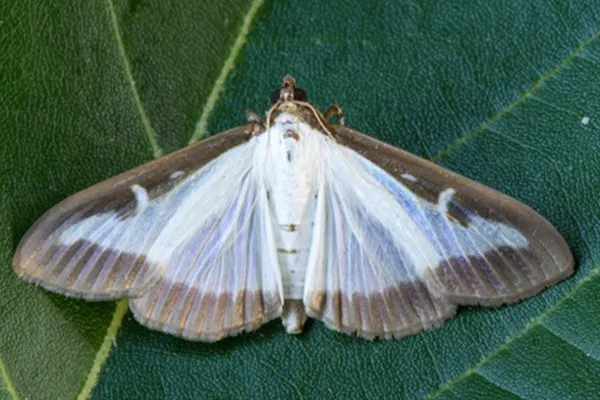
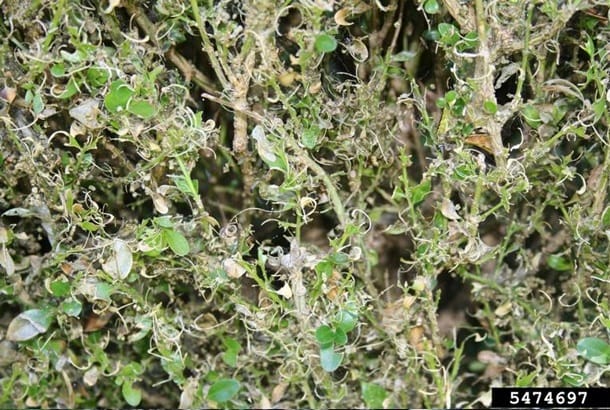
Adult box tree moth (Cydalima perspectalis). The distinctive white wings with brown borders make this moth identifiable on sight. Photo: Andrei Sourakov, Florida Museum of Natural History / Bugwood.orgBox tree moth caterpillar damage on Buxus. Caterpillars can reduce leaves to papery skeletons and strip foliage to the midrib. Older caterpillars build webs as seen here. Infestations can kill boxwood plants outright. Photo: Ferenc Lakatos, University of Sopron / Bugwood.org
Box tree moth is an invasive insect native to East Asia that has been advancing steadily across the northeastern United States since its first confirmed detection in New York State in 2021. In the years since, it has been confirmed in Delaware, Pennsylvania, Massachusetts, Maryland, West Virginia, Ohio, and Michigan — putting New Jersey squarely in its path. As of late 2024, USDA APHIS had established formal quarantines in both Delaware and Erie County, Pennsylvania. The question for New Jersey is no longer whether box tree moth will arrive, but when.
The pest poses a serious and specific threat to all varieties of boxwood (Buxus spp.) — one of the most widely planted shrubs in the region. The larvae feed aggressively on foliage and, in heavy infestations, will move on to bark, causing girdling that kills the plant outright. What makes box tree moth particularly challenging to manage is the speed at which damage escalates. Plants can be defoliated before most homeowners recognize that something is wrong.
What to watch for Adult moths have white wings with a distinctive brown border. Larvae are green-black striped caterpillars found among silky webbing inside the plant. Frass (green-black pellets) is often the first visible sign of an infestation. If you notice anything unusual on your boxwood, contact us promptly — early detection changes the outcome.
We are actively monitoring for box tree moth’s arrival in our service area. Once it is confirmed present, prompt and properly timed treatment is essential. Clients enrolled in a full shrub program will be covered for the applications required for control when the time comes. If you are unsure what your program includes or would like to discuss your boxwood specifically, please reach out.
Disease — Urgent
Beech Leaf Disease
Litylenchus crenatae mccannii
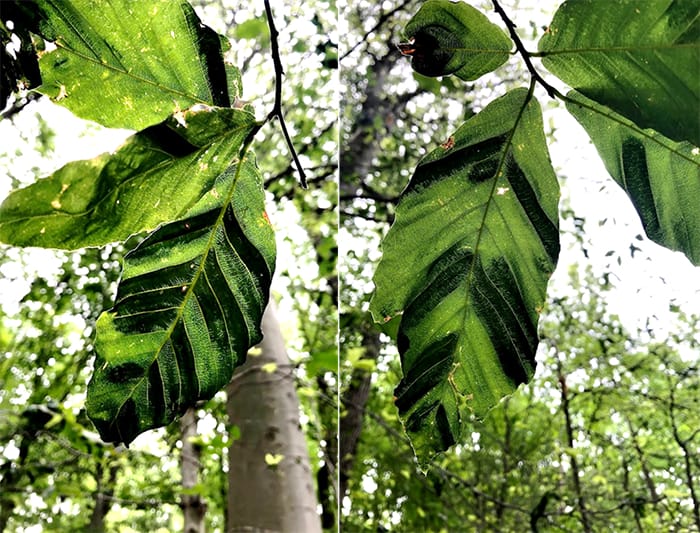
Symptomatic beech leaves afflicted with beech leaf disease. Photographed against the light sky to reveal the opaque banding of diseased leaf tissue — an early and indicative symptom of BLD. Photo: Jean Epiphan, Rutgers Cooperative Extension.
Beech leaf disease is, without qualification, one of the most serious threats to New Jersey’s tree canopy in modern memory. It is caused by a microscopic foliar nematode — Litylenchus crenatae mccannii — that overwinters inside leaf buds, damages developing leaves from within, and progressively destroys a tree’s ability to photosynthesize and sustain itself. First confirmed in New Jersey in 2020 in Bergen and Essex counties, it has since spread to nearly every county in the northern half of the state, with detections reaching Camden and Gloucester counties as recently as 2024.
The comparison to emerald ash borer and the loss of the ash is not hyperbole. Experts at Rutgers Cooperative Extension project that most infected beech trees in forested settings will die within five to ten years. In landscapes, the outcome for individual specimen trees depends almost entirely on whether treatment begins before the disease has progressed significantly. Trees with more than fifty percent dieback or defoliation are considered poor candidates for treatment. The window is real — and it is narrowing.
Why the timing matters this season Current treatment protocols — including Arbotect 20-S trunk injection (which carries a special supplemental label in New Jersey), foliar applications of fluopyram-based nematicides, and phosphite fertilization (full protocol details, Rutgers NJAES) — show meaningful results on trees in earlier stages of infection. The earlier treatment begins, the more the tree has to work with. If your property has beech trees and you have not yet had an assessment, this season is the one that matters.
It bears noting that large-scale treatment of forested beech populations is not considered practical or cost-effective — the focus must be on saving specimen and high-value landscape trees, which is precisely where our program is directed.
Invasive Pest
Hemlock Woolly Adelgid
Adelges tsugae
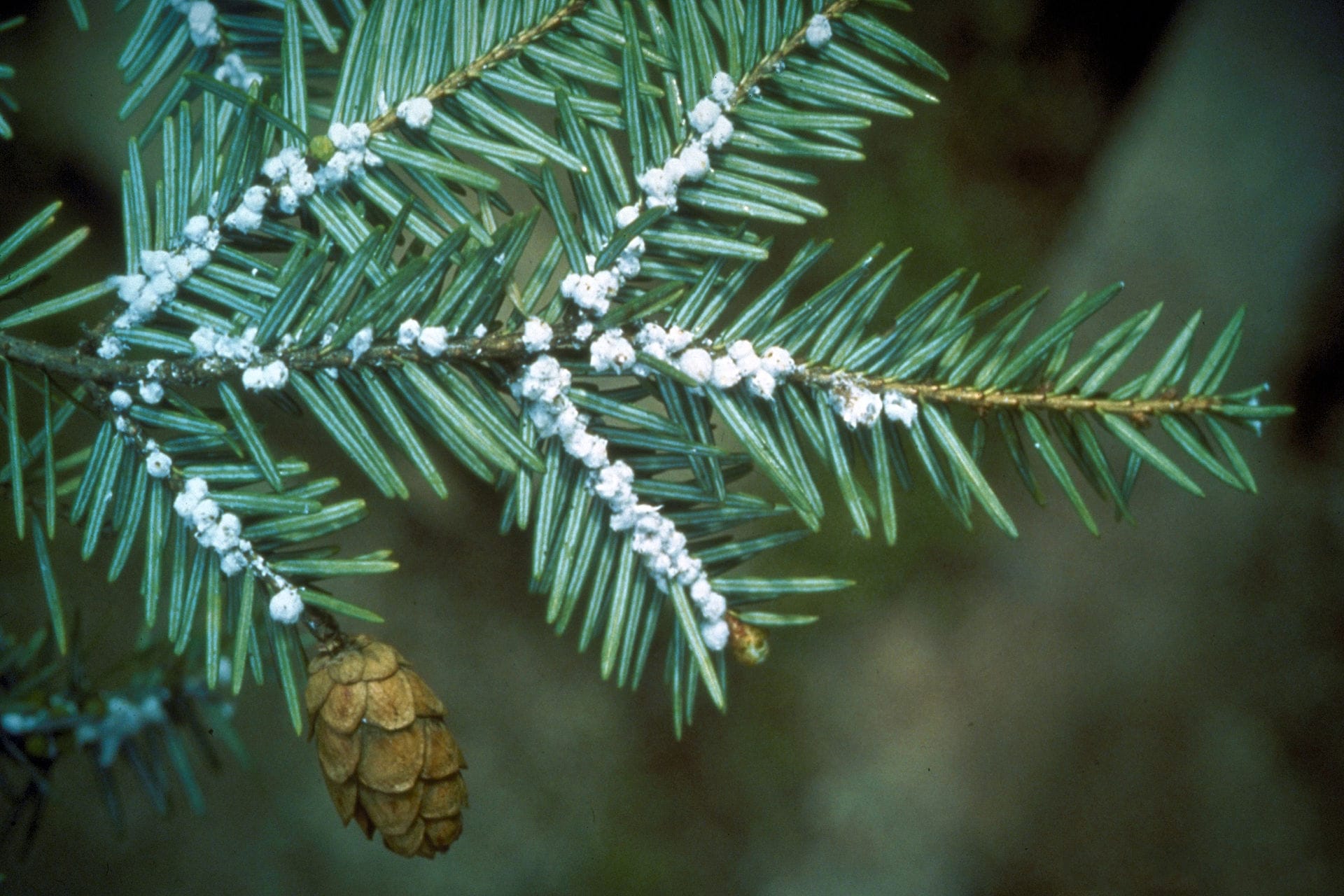
White woolly egg masses (ovisacs) of Adelges tsugae coating the base of eastern hemlock needles. The presence of these masses is the most visible and reliable sign of infestation. Photo: Connecticut Agricultural Experiment Station Archive / Bugwood.org, CC BY 3.0 US.
Hemlock woolly adelgid has been established in New Jersey for decades and remains one of the more persistent threats to eastern hemlock (Tsuga canadensis) — a tree that functions as a keystone species in our regional forest ecosystem, providing critical shade, erosion control, and habitat that few other species can replicate. Native to Asia, where hemlocks have developed resistance to it, the adelgid has no such natural check in eastern North America, and untreated trees face near-certain decline.
What makes hemlock woolly adelgid particularly insidious is precisely its subtlety. It is an active pest in winter, when most people are not paying attention to their trees. It feeds on nutrient reserves within the needles, gradually depleting the tree’s vigor without producing dramatic early symptoms. The changes are subtle enough season to season that by the time something looks visibly wrong — graying needles, branch dieback, a thinning canopy — the decline has often been quietly underway for years and reached a stage that is significantly harder to reverse. This past winter, while cold, may not have been sufficient to meaningfully suppress populations, and hemlocks that are not being actively monitored and treated remain at real risk.
Effective management options include systemic insecticide applications — soil injection or trunk injection of imidacloprid or dinotefuran — which can provide protection for multiple years when applied correctly and at the right time. See Rutgers Cooperative Extension Fact Sheet FS751 for NJ-specific management guidance. Early identification remains the single most important factor in successful treatment.
Disease & Decline
Oak Decline and Bacterial Leaf Scorch
Xylella fastidiosa and related stressors
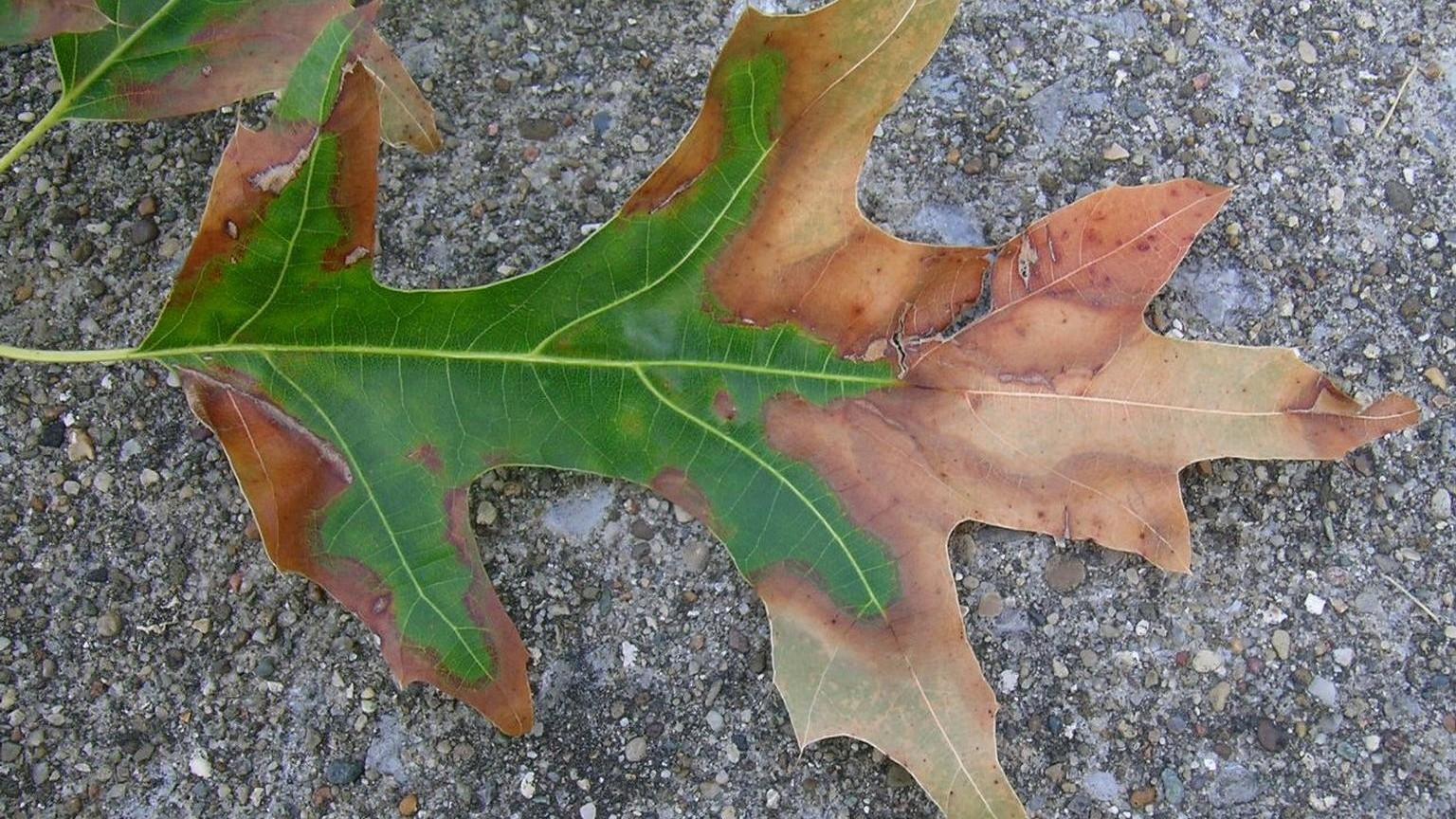
Characteristic marginal leaf scorch on pin oak (Quercus palustris) caused by bacterial leaf scorch (Xylella fastidiosa). Photo: John Hartman, University of Kentucky / Bugwood.org.
Mature oaks are frequently the most historically and ecologically significant trees on a New Jersey property. They are also, increasingly, among the most vulnerable. Oak decline — a broad term encompassing a range of environmental stressors, secondary pests, and bacterial infection — and bacterial leaf scorch caused by Xylella fastidiosa are both appearing with greater frequency across the state (Rutgers Extension: Oak Leaf Scorch, FS875), and the 2024 New Jersey Forest Health Highlights report specifically flagged bacterial leaf scorch as a growing concern in regional oak populations.
The challenge with oak decline is the same as with hemlock woolly adelgid: it unfolds slowly, and that slowness works against the tree. A mature oak under chronic stress from compacted soils, drought, or disease may show only subtle signs of reduced vigor for several seasons before the decline becomes visually apparent. By the time a property owner notices something is wrong, the tree has often already lost significant ground. The cumulative nature of the damage is what makes it so difficult — and so important to catch early.
Treatment options that can make a difference When used strategically on trees in earlier stages of decline, trunk injections, deep root fertilization, and growth regulators have each demonstrated meaningful results. The right combination depends on the specific tree, its condition, and the contributing stressors. If you have mature oaks on your property, a professional assessment is the right starting point. Reach out and we can discuss what makes sense.
Climate & Care
Drought Stress and Deep Root Watering
New Jersey summers have grown increasingly demanding for landscape plants. Warmer baseline temperatures, prolonged dry stretches, and the stress that follows difficult winters like this past one mean that many trees and shrubs are entering the growing season with reduced reserves and less resilience than they might otherwise have. This is not a seasonal anomaly — it is a pattern, and it reflects the broader reality of a shifting climate.
In response to these changing conditions, we are introducing deep root watering as a formal service this season. The approach is straightforward: water is delivered directly to the root zone through subsurface injection, bypassing the soil compaction and surface runoff that limit the effectiveness of conventional irrigation. But the benefits extend beyond hydration. The injection process creates macropore space in the soil — channels that improve aeration, drainage, and root penetration in ways that persist long after any single watering event. For trees under stress, the combination of direct moisture delivery and improved soil structure can be genuinely restorative.
For properties with mature trees, established specimen plantings, or any trees that showed signs of stress last summer, this is a service worth discussing. Please reach out if you’d like to learn more.
Public Health & Landscape
Tick Pressure and Landscape Management
The blacklegged tick (Ixodes scapularis) — the primary vector of Lyme disease — has expanded its range and populations significantly across New Jersey over the past decade, and the trend is continuing. This is a public health issue that intersects directly with how a landscape is structured and maintained. Dense understory plantings, accumulated leaf litter, edge habitats where lawn meets shrub beds, and any features that attract deer all contribute to favorable tick habitat on a residential property.
Proactive landscape care — thoughtful pruning, ground cover management, appropriate plant selection, and targeted treatments — plays a measurable role in reducing tick pressure. It is one of the more direct ways that the health of a landscape and the health of the people who use it overlap, and it is something we factor into our recommendations as we assess each property.
References & Further Reading
Rutgers NJAES. Beech Leaf Disease & Management Options.njaes.rutgers.edu/E376/ — Comprehensive guidance on BLD treatment protocols, including Arbotect 20-S and phosphite fertilization, with New Jersey-specific context.
New Jersey Landscape Contractors Association. Beech Leaf Disease Updates. August 2024. njlca.org — Field-level treatment summary prepared by Joel Flager; includes Rutgers Cooperative Extension recommendations.
Rutgers Plant & Pest Advisory. APHIS Establishes BTM Quarantines in Delaware and Pennsylvania. December 2024. plant-pest-advisory.rutgers.edu — Regional update on box tree moth quarantine expansion.
USDA Forest Service. New Jersey Forest Health Highlights 2024.fs.usda.gov — Cooperative Lands Highlights — Includes county-level BLD detection map, bacterial leaf scorch data, and EAB updates for NJ.
Rutgers NJAES. The Hemlock Woolly Adelgid: Life Cycle, Monitoring, and Pest Management in New Jersey. FS751. njaes.rutgers.edu/fs751/ — New Jersey-specific HWA management publication.
Cornell Cooperative Extension. Hemlock Woolly Adelgid.ulster.cce.cornell.edu — Life cycle, identification, and management of Adelges tsugae in the Northeast.
Tree Care Industry Association. The Box Tree Moth: Coming Soon to a Neighborhood Near You! February 2025. tcimag.tcia.org — Range modeling and spread trajectory analysis for BTM in North America.
Questions about your property or your current program? Our certified arborists are here to help — and the earlier a concern is identified, the more we can do about it.
Beech Leaf Disease (BLD) is an emerging forest health issue that is raising concern among arborists, environmentalists, and property owners alike. First identified in Ohio in 2012, this condition is now…
Creating and maintaining a stunning home landscape—especially on larger estates—involves far more than mowing the lawn or watering the flowerbeds. At Peters–Todd’s Inc., we believe in a proactive, holistic approach…
Lightning is a natural and powerful phenomenon that can cause significant damage to shade trees, leading to potential safety hazards, costly property damage, and loss of valuable landscape assets. Implementing…